


A Southwest Farewell: Five Paintings for Mom and Dad

In February 2022, I found myself in Albuquerque, staying in my parents’ house alone. My dad had passed in 2019, and my mom had just moved into an assisted living facility she had chosen for herself. It was the right decision, but we all knew deep down she wouldn’t linger long after leaving her home.
During those quiet days, the house felt heavy. I busied myself with cleaning, organizing, shredding — all the practical tasks of preparing for the estate. But there are only so many papers you can sort before the silence starts to echo. I needed something to do with my hands, something that wasn’t about endings. So I went to Michaels and picked up a couple of sets of fluid acrylics — one in a cool, wintry palette, the other in desert southwest tones.
In the cold Albuquerque air, I poured paint across four blank canvases, letting color flow and pool. The temperatures were nothing like Austin, where I’d been painting before, and the paint behaved differently, stubbornly slow, unpredictable. But that felt fitting. Life was unpredictable, too. Those four canvases became my way of holding steady during that month of waiting.
Not even a week after I returned home at the end of February, I got the call that my mom was unresponsive. I flew back immediately, and the next day, she passed. After the whirlwind of cremation, paperwork, planning, and saying goodbye, I eventually returned to my own home with those four canvases — the last things I had made in the time I still had a mother. I knew I had to finish them, to turn them into something more.
Dad’s Roadrunner

The first canvas I completed was for my dad. While living in New Mexico, Dad had a roadrunner that used to follow him around the yard, almost like a companion. That memory had stayed with me — a bird known for its resilience, speed, and adaptability, keeping pace with my father.
I sketched the outline of a roadrunner and began building it up with joint compound, feather by feather, adding texture and life to its form. Once dry, I painted it to resemble the bird I remembered. Against the fluid acrylic background, the roadrunner emerged not just as an image, but almost as a presence — part memory, part sculpture, part painting. For me, it was a way of keeping him close, of honoring the simple companionship he’d had with that bird.
Mom’s Dreamcatcher

For my mom, the image came easily. She had dreamcatchers hanging in nearly every room of her house — symbols of protection and heritage that quietly watched over her space.
Using a pastry tube, I piped out the form of a dreamcatcher in joint compound, weaving its lines in raised relief. I pressed in beads I had cut in half, added feathers, and layered on touches of silver leaf and glitter. The piece became both delicate and strong, just like her. It was my way of capturing her presence — a reminder of how she made her home beautiful in ways both practical and symbolic.
Kokopelli

The third canvas drew on a figure woven deep into the American Southwest: Kokopelli. A fertility deity, a trickster, a bringer of music and joy, Kokopelli has been carved into rock walls for centuries.
This piece felt especially fitting because both of my parents were musicians. My mom sang professionally when she was younger — she even had her own radio program and headlined in Las Vegas for a time. She also played the piano with a grace that filled the house. My dad played in several jazz combos on the East Coast, his first love being the saxophone, though he also picked up the standing bass. Music was in their blood, woven into the fabric of their lives.
When I shaped Kokopelli in textured relief and painted him against the flowing acrylics, it felt like a tribute to that musical legacy. Kokopelli’s flute became not just a cultural symbol but a reminder of my parents’ voices and instruments, still echoing through memory. For me, Kokopelli represented joy breaking through grief, music flowing even when silence pressed heavily.
Chili Peppers
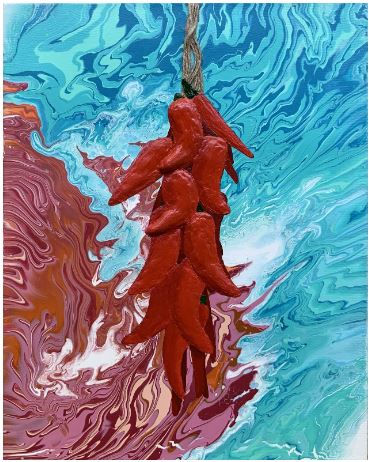
The fourth canvas was simple, vibrant, everyday: chilies. Nothing says New Mexico quite like strings of red chilies drying in the sun, glowing with heat and flavor.
I built their forms with joint compound, creating texture and shape, then painted them with fiery reds and deep shadows. This piece grounded the set — less about memory, more about place. Chilies were always there, part of daily life, part of the culture my parents had chosen when they settled in Albuquerque.
Golden Arrows

The final painting I completed in this series was Golden Arrows. Somehow, I had nearly forgotten it in my mind’s recounting, but when I came across the image, I realized it was the quiet anchor that brought the series together.
This canvas, with its radiant red, pink, and turquoise swirls beneath a formation of gold arrows, speaks to movement, direction, and possibility. The arrows point left or right — backward, forward, outward, onward — each one a symbolic gesture toward the future, toward remembering while continuing on.
Created with a thin layer of texture paste and gold leaf, the arrows are bold but elegant, shining against the fluid background. They remind me that even in grief, we are still called forward. Even as I painted in a house filled with memory, this piece gave me a sense of movement — a way to step into the next chapter.
Golden Arrows closes the series with a message: what we carry with us matters. But so does the path ahead.
A Cycle of Memory and Transition
Taken together, these five paintings became more than just experiments with fluid acrylics and various texture mediums. They became a cycle of memory, each piece tied to my parents and the life they had built together in the Southwest.
Dad’s Roadrunner carried his quiet companionship, Mom’s Dreamcatcher held her protective spirit, Kokopelli sang of their shared love of music, while Chilies rooted it all in the vibrancy of place. And Golden Arrows pointed to the way forward — a path through grief, through memory, and into whatever comes next.
Finishing them helped me move through grief. They reminded me that even in loss, there are ways to carry forward what was beautiful, what was grounding, what was full of life.
Art doesn’t erase grief, but it gives it form. It gives us a way to hold onto what matters, to turn memory into something we can see and touch. These five paintings will always be a reminder of that last month with my mom, of my dad’s enduring presence, and of the landscapes — both physical and emotional — that shaped us.
Maybe you, too, have objects, colors, or images that tether you to loved ones. For me, it was four canvases. For you, it might be something else. Either way, art gives us a way to remember.
Explore More
If you’d like to see these works and other sculpture/relief paintings, visit my Google Sites Gallery https://sites.google.com/view/dixon-valentine-studios/galleries/sculpture-paintings-and-bas-relief.
Follow along on Instagram @dixonvalentinestudios, @dixon.valentinestudios or Facebook @Dixon-ValentineStudios for new artwork, reflections, and updates.


Comments